
Types of fire hose
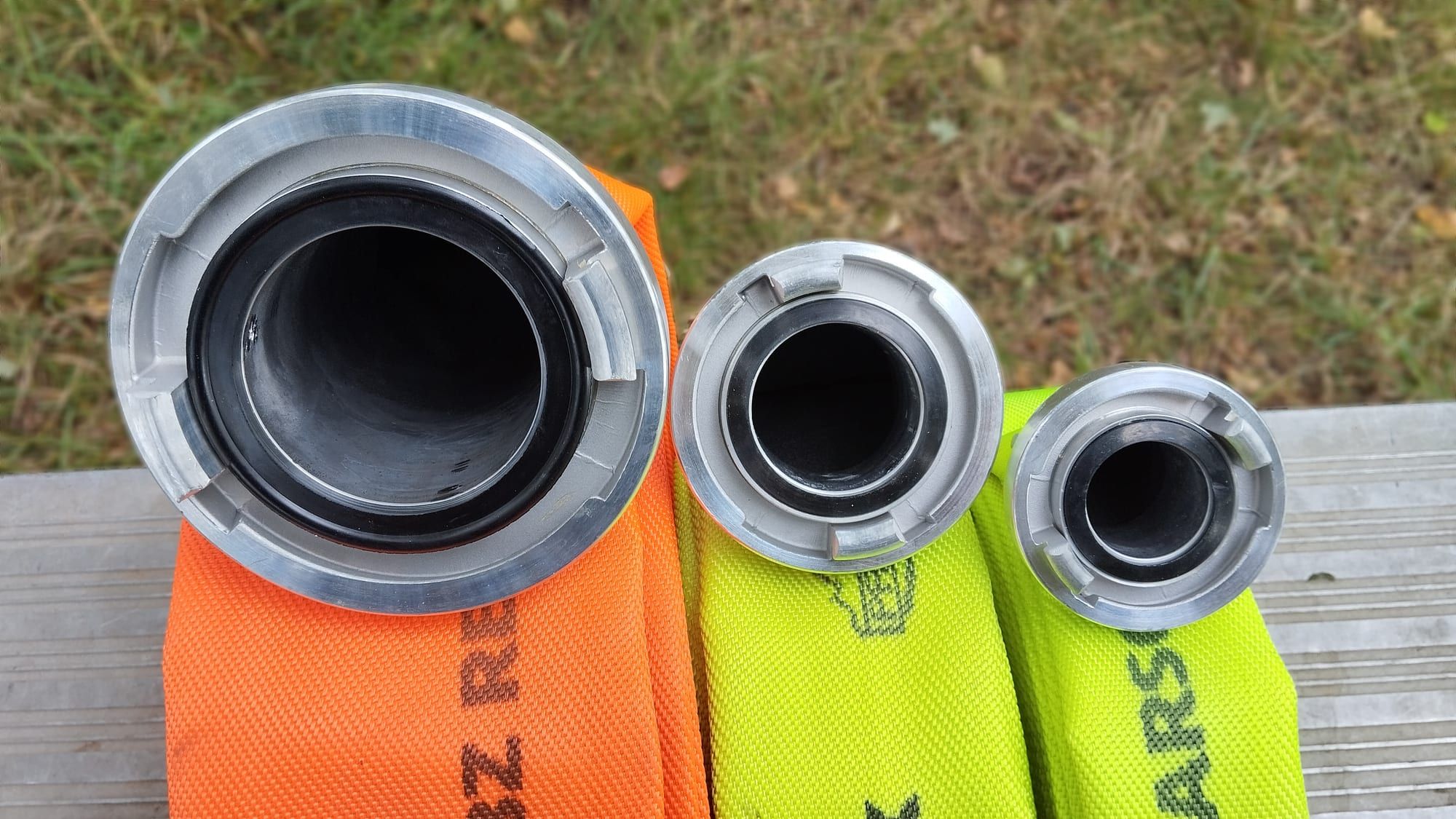

Fire hoses are not all the same. They differ in how they are used, how wide they are and how they connect. This is a short overview of what you usually find on a fire engine.
Delivery, suction and semi-rigid hose
Delivery hose carries water under pressure from the pump or hydrant to the nozzle. It lies flat when empty, so it rolls up and packs away easily. This is the hose used on almost every call.
Suction hose is used to draw water from an open source, such as a river, lake or pool, with the pump. It is rigid and reinforced with a spiral, because drafting creates a vacuum inside it that would flatten an ordinary hose.
Semi-rigid hose keeps its round shape even when empty. It is usually connected to the pump permanently and wound on a hose reel, so it can be used straight away without laying out and coupling.
Designations and sizes
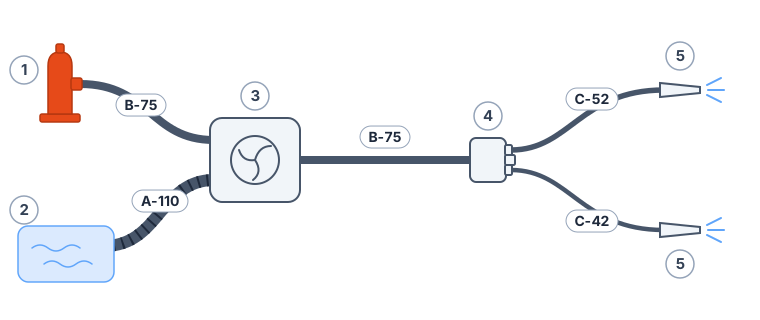
In Central and Southeast Europe, delivery and suction hoses are marked with a letter and a number, following the German system. The letter is the coupling size and the number is the inner diameter in millimetres.
| Designation | Diameter | Used for |
|---|---|---|
| A-110 | 110 mm | drafting from open water |
| B-75 | 75 mm | supply lines, from a hydrant or tanker to the distributor |
| C-52 | 52 mm | attack lines, from the distributor to the nozzle |
| C-42 | 42 mm | attack lines, lighter and easier to carry |
| D-25 | 25 mm | low flows, vegetation fires and mop-up |
B hose usually comes in 20 m lengths and C hose in 15 m lengths.
Why diameter matters
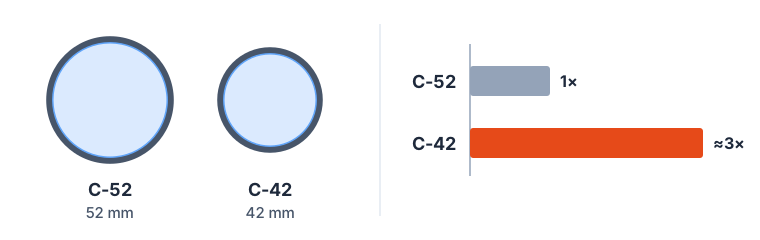
The narrower the hose, the more pressure the water loses to friction. The difference is bigger than it looks: at the same flow and length, a C-42 loses almost three times as much pressure as a C-52. That is why long supply lines use B hose and attack lines are kept as short as possible. A narrower hose is lighter and easier to handle, especially on stairs, so the choice is always a trade-off between mobility and pressure at the nozzle.
Couplings
Hoses connect with Storz couplings. They are symmetrical, with no male or female end, so any two ends of the same size connect by pushing them together and turning. C-52 and C-42 share the same C coupling and connect to each other. Hoses of different sizes, for example B and C, connect through an adapter.
What they are made of
A delivery hose has an outer jacket woven from synthetic fibres, which takes the pressure, and an inner rubber lining that keeps the water in. Some hoses also have an outer coating that protects them from abrasion, heat and chemicals.